
Resilient Communications in Cambridgeshire
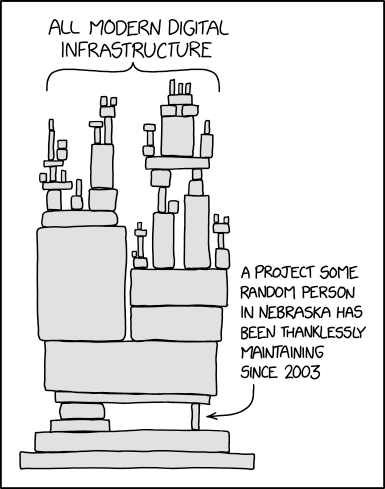
Modern society is highly dependent on services provided by an infrastructure that very few understand. Amongst practising engineers and maintainers, the illustrative cartoon is famously shared and reshared in discussion groups and commentary not only because it's amusing but it's also a grim metaphor for the reality, a single forgotten component supporting everything else. And it doesn't apply just to digital infrastructure.[*1]
The critical pillar is often surprising when you discover it. The UK economy is extraordinarily dependent on Global Navigation Satellite Systems (GNSS) for timing signals (Royal Academy of Engineering[4] March 2011) to the extent that even the Government is belatedly taking action (DSIT[5] March 2025). Especially surprising, maybe, is the dependency on accurate satellite time of the electrical power grid. The most widely used such system is owned and operated by the US military for their own benefit and in principle they could turn it off.[*2]
Dependency on Digital
Card payment systems, food & fuel distribution and reordering systems and countless other aspects of day to day life are utterly dependent on digital communications behind the scenes. Social dependency on landline and mobile phones, as well as internet in general, are so obvious they hardly need mention.
Landline phones used to be reliable even during power cuts because household phones were powered over copper wire from telephone exchanges which had massive battery backup. Copper wire is now being phased out and replaced with fibre which cannot provide power to the premises.
"The transition away from last-mile copper infrastructure - primarily the Public Switched Telephone Network (PSTN) - to fiber-optic networks is a major, yet controversial, modernization effort in the UK, US, and other regions. While promised for enhanced speed and reduced maintenance, the process faces significant backlash regarding the safety of vulnerable users, accelerated timelines, and technical challenges"
Communications infrastructure, both voice and data, is entirely capable of collapsing of its own accord even without malicious interference, a risk that the National Risk Register[7] cites along with other potential causes.
Telephony outages in the UK have evolved from late-19th-century trunk line issues and poor service prompting nationalization to modern, large-scale mobile/landline outages caused by infrastructure failures, exemplified by major EE, BT, and Vodafone disruptions in July 2025 affecting thousands of users for multiple days.
In 2024, wildfires burnt through two key fibre optic cables, depriving parts of Canadian North West Territories and Yukon of all telecommunications
... unless you have a Starlink or a device like that, then you don't have any access to the outside world but you also can't phone 911. You can't call the police, can't call the health center. You can't call if you see a fire, so there were real issues that that creates inside small isolated communities.
Dependency on Electricity
The digital infrastructure is itself almost entirely dependent on reliable electricity supplies. Landline phones fed by fibre require power to work, cellular (mobile) phones rely on base stations within 35km[*3] and those rarely have backup power beyond an hour or two with many having none. Broadly speaking, telephony and internet access are dependent on mains electricity.
The UK's national electricity grid[9] has its roots stretching back to the 1930s augmented by substantial investment during (roughly) the 1960s. The very high voltages used to reduce transmission losses are reduced to usable levels for distribution through very large (i.e. expensive) transformers, the average age of which now is approximately 63 years[*4] versus an actual design life of 35-40 years.
In March 2025, Heathrow airport was shut down for 24 hours due to the failure of such a transformer at North Hyde occasioned by "a catastrophic failure on one of the transformer's high voltage bushings"[10] according to the final report from NESO.
On the 9th of August 2019, the grid was under stress from the loss of two large generators. A lightning strike was enough to cause loss of power to nearly a million people in England and Wales[11][12][13].
On the 5th December 2015 Storm Desmond[14] caused extensive loss of power to the city of Lancaster for approximately 24 hours resulting in a near-total loss of telephone and internet communications. The subsequent report by the Royal Academy of Engineers[15] (RAE) is essential reading for anyone interested in emergency planning, see also the Hurricane Katrina report by the US Military.[*5].
As the RAE report states, the loss of civilian communications is disorienting to the general public and greatly hampers attempts by authorities to react. The likely effects were underscored in Cambridgeshire during 'Exercise Mighty Oak', a government-sponsored three-day exercise held in March 2023 to model the effects of a multi-day national power outage. Whilst there is little public information available about the results, insiders describe the consequences as disturbing.
In summary: existing communications systems can fail of their own accord and, in any case, are entirely dependent on a creaking electricity grid system which cannot be assumed to be infallible. Any lengthy failure will be profoundly unpleasant.
Resilient Radio Systems
In times of emergency, 'old-fashioned' infrastructure-free radio communication systems still keep working, as can more complex systems if they have planned resilience.
The Emergency Services use a communications system known as Airwave.[17] which is designed to be partly resilient to wide-scale power outages. It is hard to find anyone who can reliably vouch for its resilience, but the design includes sites with generator backup which, if they are suitably maintained, are intended to give a degraded level of service when running without grid power.
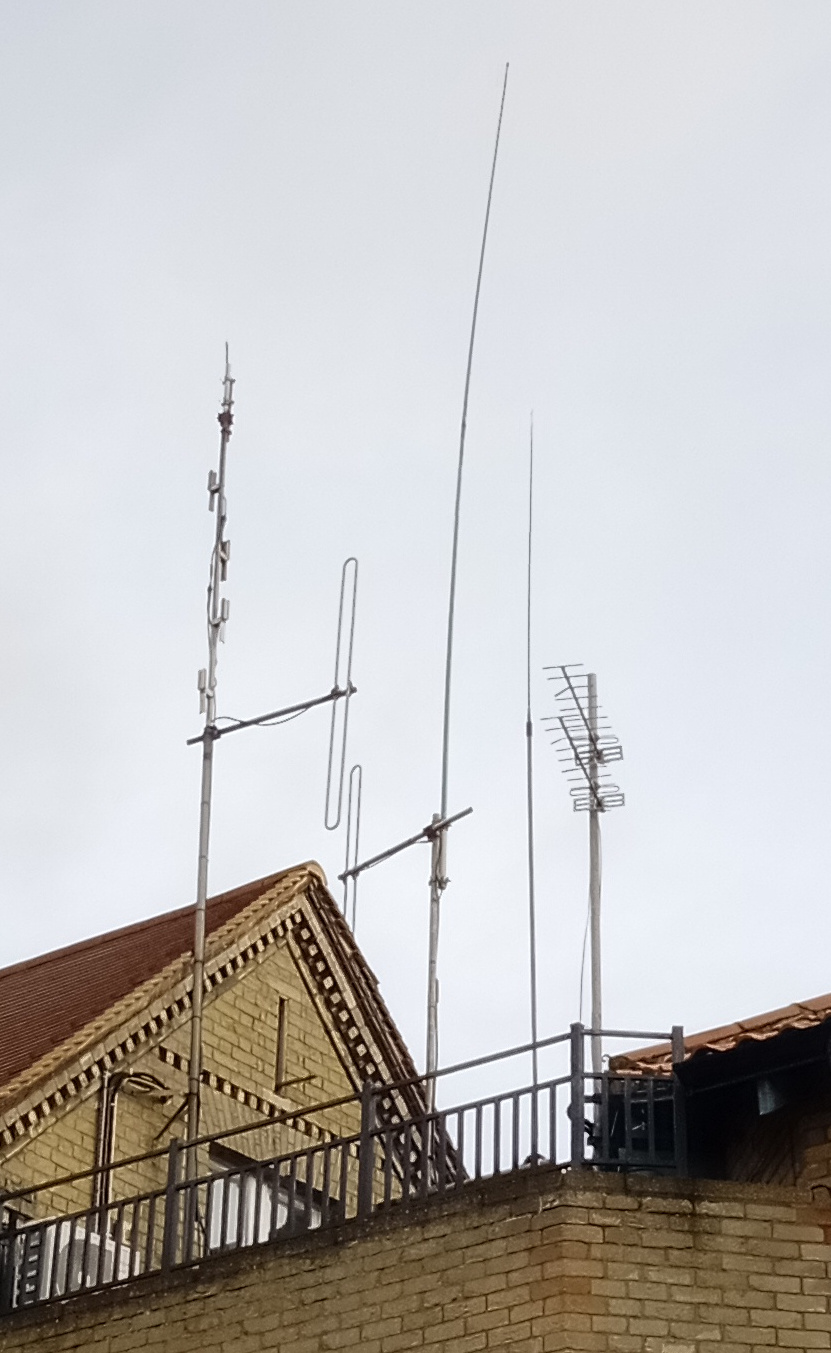
Apart from the Emergency Services, and unless alternative resilient communications have been put in place, civilians and civil authorities alike will be left unable to communicate with each other during infrastructure failures. During the Cold War and up to around the '90s, there were radio rooms in many local authority establishments, equipped and maintained by the voluntary Cambridgeshire Raynet group but those are now long gone and unreplaced. Rusting radio antennas still exist as testament on the roof of the East Cambs building.[*6]
Cambridgeshire Raynet provides volunteers and equipment which can be used in situations where normal communications have been lost. Cambridgeshire is a benign (read geographically flat) environment for radio communications and county-wide coverage is achievable with effort whilst distances of 20 miles / 30 km are not a great challenge. The volunteers and equipment are enough to help in a short-term and strictly local event. No matter how hard they try, the efforts of a modestly-sized volunteer group are, however, going to be swamped in the case of a long-lasting county-wide communications failure.
Of particular concern and as highlighted in the RAE report, rest centres are likely quickly to attract large numbers of the public looking for information. Even more worrying may be that, due to the loss of access to the 999 service, it's predictable that those are the locations where medical emergencies will present themselves, hoping to be able to get critical medical care. Should that not be available, loss of life is also predictable. These concerns are reflected in a report by OFCOM into telecommunications resilience, parts of which are redacted for publication, for example where it gives availability figures for emergency calling[18].
As the duration of an outage increases fewer consumers can make emergency calls: only around [redacted] could make an emergency call in the event of a power outage lasting up to 6 hours. This is because far fewer (5%) sites [redacted] have backup facilities of at least 6 hours.
In 2017, 70% of calls to emergency services were made from mobile phones. Ofcom rules require telecoms providers to take "all necessary measures to ensure their customers can call the emergency services during a power cut", yet only identifies those relying on a landline as 'at risk'. Such rules are written with the expectation that mobile networks will continue to function, assumptions which will likely be challenged in the event of weather-related disruption.
Untapped Potential
One potential way of providing organised communications from rest centres would be to ask the general amateur radio community to get involved. Precise figures are hard to come by but it's thought that Cambridgeshire is home to several hundred Radio Amateurs ('hams'), a large proportion of whom who have hand-held, vehicle-mounted and home-based radio equipment well-suited to the task. They will be present in most localities large enough to have a rest centre. A substantial body of skill and equipment is already out there, waiting to be called on. Amateur Radio equipment is often designed to be battery-operated to ease vehicle use, all that is needed for resilience being a battery.

As well as personally owned equipment, Cambridgeshire is home to numerous radio repeaters funded and managed by the hams. These are powerful radio systems at advantageous locations which take a weak radio signal and rebroadcast it over a wider area. As an example the repeater at Barkway known as GB3PI[20] offers coverage to vehicles from roughly North London to Kings Lynn and to hand held radios at maybe a third of that range[*7]. There are voice repeaters with good coverage located at Barkway(ibid), Madingley[21], Peterborough[22] and Huntingdon[23] as well as a number of shorter-range variants[*8]. These are not necessarily resilient but with modest investment in batteries could be made so, along the lines of the Madingley device which already has batteries.
Enquiries of a number of potential volunteers reveals a considerable willingness amongst them to help in a genuine emergency if asked. To have volunteers without a plan is, however, unlikely to work smoothly.[*9] There is more to effective communications than to have a volunteer turn up un-briefed and unrehearsed no matter how keen or well-equipped. There is also the endemic problem of insurance when working with ad-hoc volunteers. Lack of liability cover can be a show-stopper when trying to organise volunteer efforts and cannot be airily dismissed, it must be addressed up-front.
The UK stands in contrast to the USA, the latter having a formally organised structure for the use of Amateur Radio in emergencies, where The Radio Amateur Civil Emergency Service[24] is recognised in legislation and there is active cooperation with the Federal Emergency Management Agency (FEMA)[25].
The largest disaster response by U.S. amateur radio operators was during Hurricane Katrina which first made landfall as a Category 1 hurricane went through Miami, Florida on August 25, 2005, eventually strengthening to Category 5. More than a thousand ham operators from all over the U.S. converged on the Gulf Coast in an effort to provide emergency communications assistance. Subsequent Congressional hearings highlighted the Amateur Radio response as one of the few examples of what went right in the disaster relief effort.
Cambridgeshire lacks a resilient communications network for use in civil emergencies. We in Cambridgeshire Raynet think this is a considerable omission and are, as of 2026, attempting to make the options better known.
References
- ^ Renowned cartoon by XKCD on infrastucture fragility
- ^ Wikipedia entry on the XZ vulnerability
- ^ Youtube video on the XZ vulnerability
- ^ Royal Academy of Engineering study on dependency of UK on satellite navigation systems
- ^ UK DSIT action on reducing dependency on satellite navigation systems
- ^ National Preparedness Commission report on dependency on timing and position information
- ^ UK National Risk Register
- ^ Vancouver City News article on wildfire communications loss
- ^ Wikipedia entry on UK National Grid
- ^ NESO report into Heathrow power outage
- ^ BBC report into August 2019 power outage
- ^ Judge Business School report on UK power outage of 9th August 2019
- ^ UK Energy Research Centre analysis of 9th August 2019 UK power outage
- ^ Wikipedia entry on Storm Desmond
- ^ Report into Storm Desmond by the Royal Academy of Engineers
- ^ US National Defense University report on Communications and Infrastructure Impacts following Hurricane Katrina
- ^ Wikipedia entry on UK Airwave system
- ^ Lengthy redacted OFCOM pdf report on mobile telephony resilience
- ^ Parliamentary evidence by Energy Research Centre on Electricity System Risks
- ^ Cambridge Repeater Group GB3PI repeater
- ^ Cambridge Repeater Group GB3PY repeater
- ^ Cambridge Repeater Group GB3PE repeater
- ^ Huntingdon ARS GB3OV repeater
- ^ Wikipedia entry on US RACES scheme
- ^ Announcement of agreement between US radio amateurs and the Federal Emergency Agency
- ^ Wikipedia item on use of amateur radio in emergencies
Footnotes
- ^ Examples of what might lie behind the cartoon could be the histories of openssl, ffmpeg and ntp amongst others, the list is long. Perhaps the most alarming is the vulnerability of key components to attacks such as the notorious XZ vulnerability[2], usually attributed to state-funded attack, which received barely any press yet could have compromised much of the Internet's infrastructure. See also this youtube exposé.[3]
- ^ There is also a report by the National Preparedness Commmission into the dependency on position and timing signals[6]
- ^ GSM mobile phone specifications have a maximum 'timing advance' setting which adjusts for the distance of the phone from the cell tower and the time taken for round-trip data exchange. Taking into account the speed of light, this restricts the maximum range to 35km or a little over 20 miles. In some very remote places this can be extended to 70km.
- ^ Found from Google search which refers to a FOI request to OFGEM
- ^ The US National Defense University report on Communications and Infrastructure Impacts following Hurricane Katrina[16] is a sobering read.
- ^ It was typical for a radio room to be equipped for Citizens' Band and the Amateur 70MHz, 144Mhz and 430Mhz frequencies. The photo shows antennas for CB, 430Mhz, two antennas thought to be for the BBC emergency local radio studio and two unrelated TV receiving antennas. One remains unidentified, probably for 144MHz.
- ^ Predicting radio range in the abstract is a mug's game as it's hugely dependent on terrain and obstructions.
- ^ The list of repeaters has been kept only to VHF/UHF FM voice repeaters, there are numerous others supporting digital voice, digital data and even amateur TV. These require suitable equipment whereas FM voice is typically the baseline 'standard'.
- ^ Having a communications link can be part of workable plan but this must also include agreement on procedures for message handling: who do you contact, when will they be available, what is the protocol for dealing with messages and acknowledging action/receipt. A documented and tested workable process is required, not merely exchanging information. There are also implications for training and exercising.