
Raynet Wide Area Power Outage Backup Voice Link Tests
Power-outage exercises such as Mighty Oak (sponsored by UK Government in March of 2023) have highlighted the vulnerability of internet and telephones (fixed and mobile), all of which are predicted to collapse rapidly when power is lost. Raynet were asked by the Cambridge and Peterborough Local Resilience Forum[1] communications working group to demonstrate that communications will be possible between key locations in emergencies where normal methods have failed.
A preliminary test was planned with a view to a full demonstration to a wider audience later (this full demonstration was subsequently cancelled in view of the videos available).
The preliminary test was performed by Cambridgeshire Raynet on 10th March 2024 to demonstrate backup radio communications in the event of loss of other forms of telephony. Using only self-powered vehicle-mounted equipment and making direct point-to-point contact independent of telephones, cellular communications or any third party, voice messages were easily passed between the respective locations. The test confirmed that communication is possible even under total power or telephony/internet failure conditions.
The primary requirement was to connect the three main Police stations. In addition to the primary requirement, Addenbrooke's Hospital and Peterborough City Council HQ at Sandmartin House were selected to show that other category 1 responders could also be accommodated.
The goal of demonstrating a viable voice path between a notional Strategic Coordinating Group operating at Hinchingbrooke and the other stations was achieved.
Test Locations
Testing was done using VHF and UHF bands; with these bands antenna height is one of the most important determinants of signal strength. The tests were conducted between:
- Hinchingbrooke Police HQ using firstly antenna on 15m mast, also later vehicle with antenna on roof
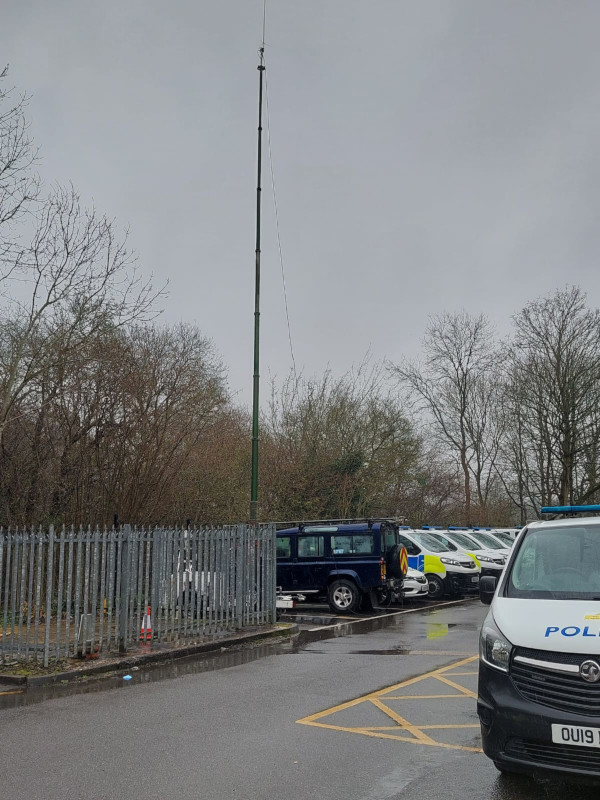
- Thorpe Wood Police Station using antenna on ex-military pump-up mast
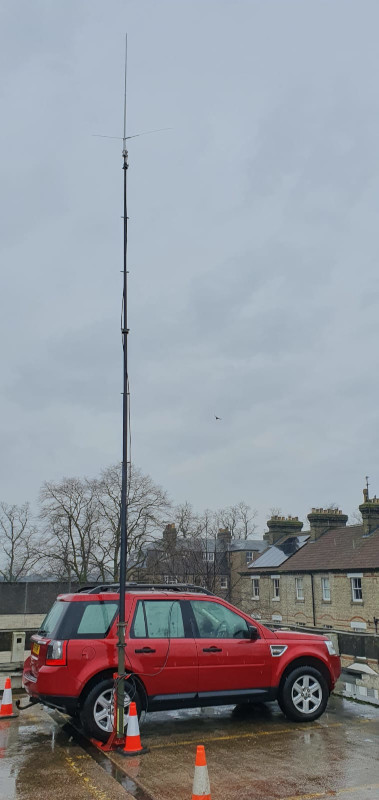
- Parkside Police Station using antenna on extensible mast
- Peterborough City Council (Sandmartin House) using vehicle with antenna on roof
- Addenbrooke's Hospital using vehicle with antenna on roof
The vehicles at Addenbrooke's and Peterborough used only roof-mounted antennas rather than fixed masts as would be expected in a permanent installation, resulting in significantly weaker signals. Signal reports were however also received from other parts of the county for information.
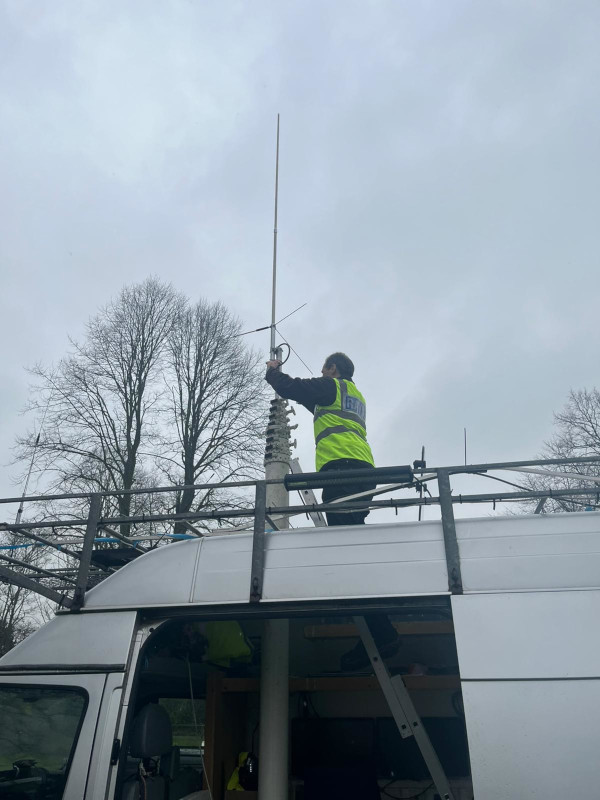
When at Hinchingbrooke, the Incident Control Vehicle (ICV) employed a pump-up mast at a lower height that could be achieved by mounting the antenna on the Police Hinchingbrooke mast, which would materially increase the strength of signals in and out of the site.
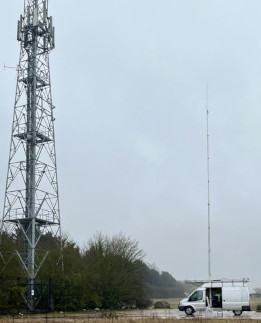 The ICV (right) later moved to Warboys on higher ground in order to repeat the test of signals from a known good location, as Hinchingbrooke Police HQ is a relatively poor location for radio. If a site like Warboys were to be selected as a communications focal point, it would be used to transparently relay signals between all the outstations - a 'repeater' station. Using a repeater would mean that any station could talk to any other at any time rather than being mediated by a master control.
As the video from Parkside shows, slightly better antennas would likely give a viable point-to-point path direct between Thorpe Wood and Parkside even though this is not a strict requirement. In the event, there was an audible but unusable signal direct between the two. Were a repeater to be used at Warboys/Hinchingbrooke base, this would not be an issue and reliable communications would be available (if needed operationally).
Conclusions
Overall, usable signals were obtained at both Hinchingbrooke and Warboys from all the stations, despite the significant compromises on the antennas available. This suggests that a permanent fixed installation with good antennas will work substantially better even than the successful tests. The software predictions that Hinchingbrooke is a mediocre site and that Warboys is much better were borne out as expected. A very large communications mast already exists at Warboys (shown in the photo) and this would be an exceptionally high-performing location for fixed antennas; the mast is thought to be owned by the Police. Another such mast at Haddenham, ownership unknown, would also be a prime location.
As expected, VHF proved to be considerably better than UHF over longer paths.
Video of Tests
Raw test footage was edited down to prepare a short presentation. References to 'blobs' in the commentary is the indicated signal strength on the radio's meter. This was converted into microvolts for the written report, which we don't link to on this site.
Photos from the tests
Vehicle at Parkside
Vehicle at Thorpe Wood
ICV at Hinchingbrooke
References
- ^ Cambridge and Peterborough Local Resilience Forum