Exercise White Nile
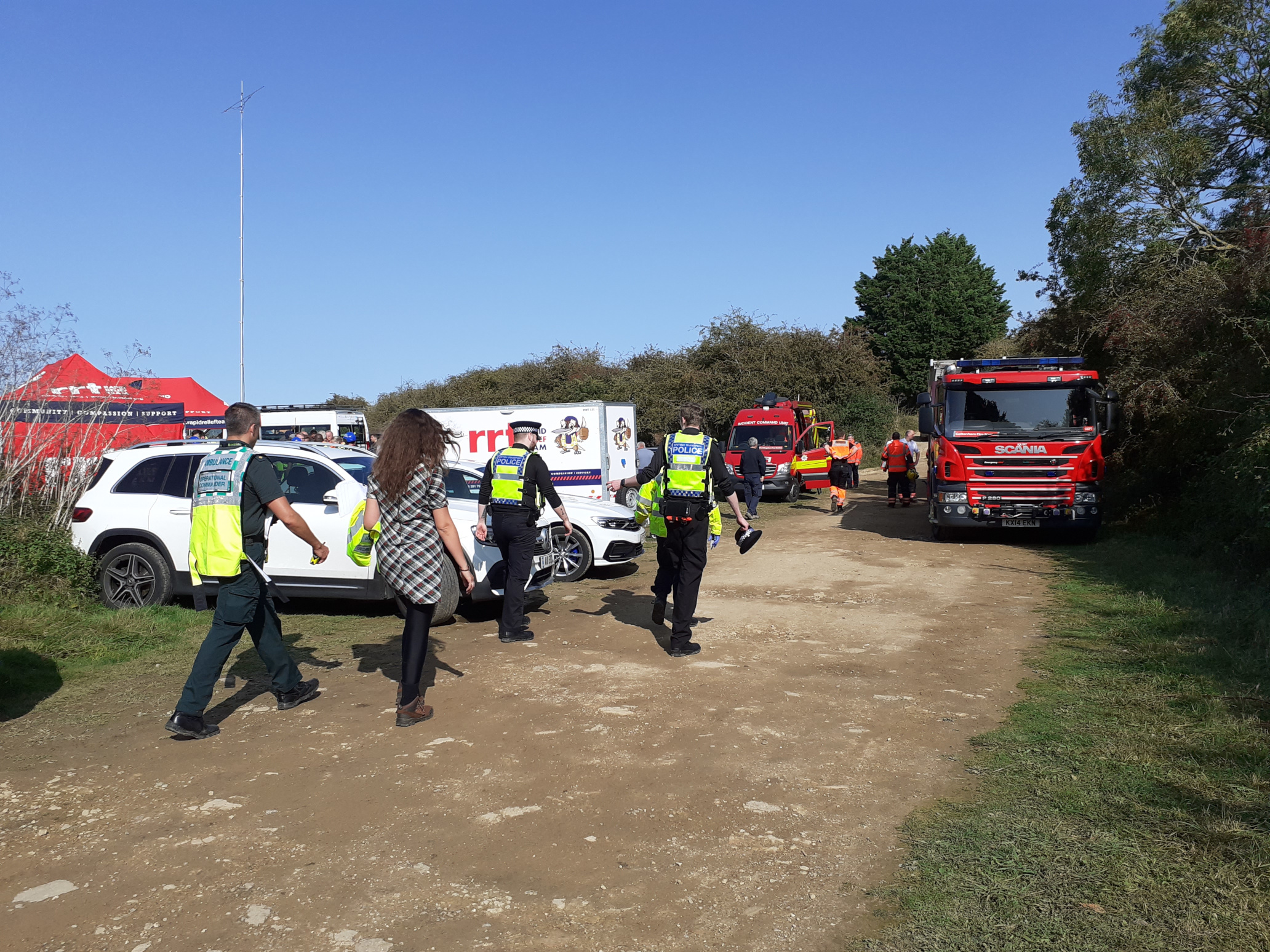
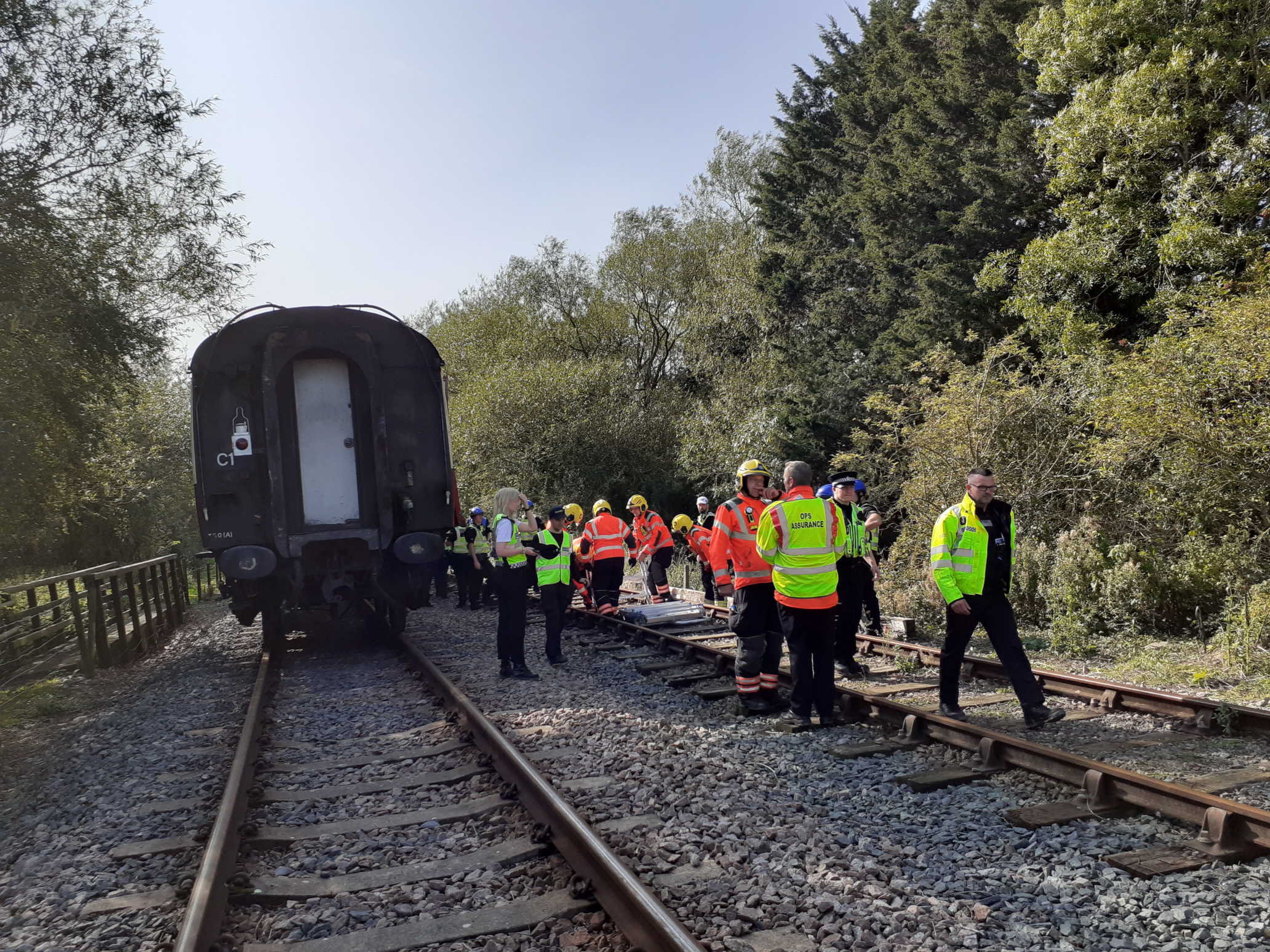
Exercise White Nile was led by British Transport Police with the goal of simulating a significant vehicle/train collision at the Waterbeach level crossing, compounded by a large fuel leak and substantial casualties. Rather than disrupting the real rail network, the exercise was held on the Nene Valley Railway at and around the Wansford end of the Wansford tunnel. This exercise was treated as a major event with all the emergency services and a number of voluntary groups in attendance.
Part of the exercise was to simulate the loss of all normal communications (Airwave radio as used by the Blue Light services and also mobile telephones). Raynet was tasked with providing voice communications on the ground with short-range hand held radios and also a voice link between Wansford and the coordinating group that had been convened at Constabulary HQ at Hinchingbrooke.
Below is a reproduction of an article written for publication about the exercise. Please note that the images used below remain copyright of their respective owners are not public domain.
A Simulated Multi-Agency Response to Rail Accident
Exercise White Nile was run in September 2023 as an exercise involving multiple agencies and responders from the Cambridge and Peterborough Local Resilience Forum (LRF) with a 'live play' portion using real trains and people working on site at Nene Valley Railway and a Tactical Coordinating Group (TCG) operating at Cambridgeshire Constabulary Headquarters, in Huntingdon.
The exercise had multiple purposes - as any exercise does - to test responses and to inform and educate those involved. It was run using JESIP principles for inter-service cooperation (JESIP[1]) and attended by Police, Fire, Ambulance, British Transport Police and a number of voluntary organisations with agreements to work with the LRF.
The exercise was intended to simulate an incident at Waterbeach level crossing (near Cambridge) involving two trains and a motor vehicle, followed by a substantial diesel fuel spillage with a resultant fire, giving all the agencies a challenge.
For the live play portion, the initial rendezvous point was Wansford Railway Station on the Nene Valley Railway, a heritage railway, on a non-railway running day so that rolling stock could be positioned at the incident site and a realistic exercise involving railway lines and rolling stock could be held. The incident site was at the western end of Wansford Tunnel, some 1.2km metres from the Wansford Station (see also an interesting technical article[2] by John Rabson et al (2011) regarding Underground Radio Tests on the Nene Valley Railway). Part-way through the exercise, there would be a simulated failure of the three emergency services' Airwave radio system and simultaneous outage of cellular telephone network and associated data communications. This is where the Cambridgeshire Group of RAYNET-UK 'stepped up to the table'.
The requirement for Cambridgeshire RAYNET was to ensure that local commanders on the ground could (a) still communicate with their own teams and (b) transfer important information regarding resources, casualties and the like to the Tactical Coordinating Group at Huntingdon some 30km away, and (c) ideally also be able to communicate with their own service control rooms.
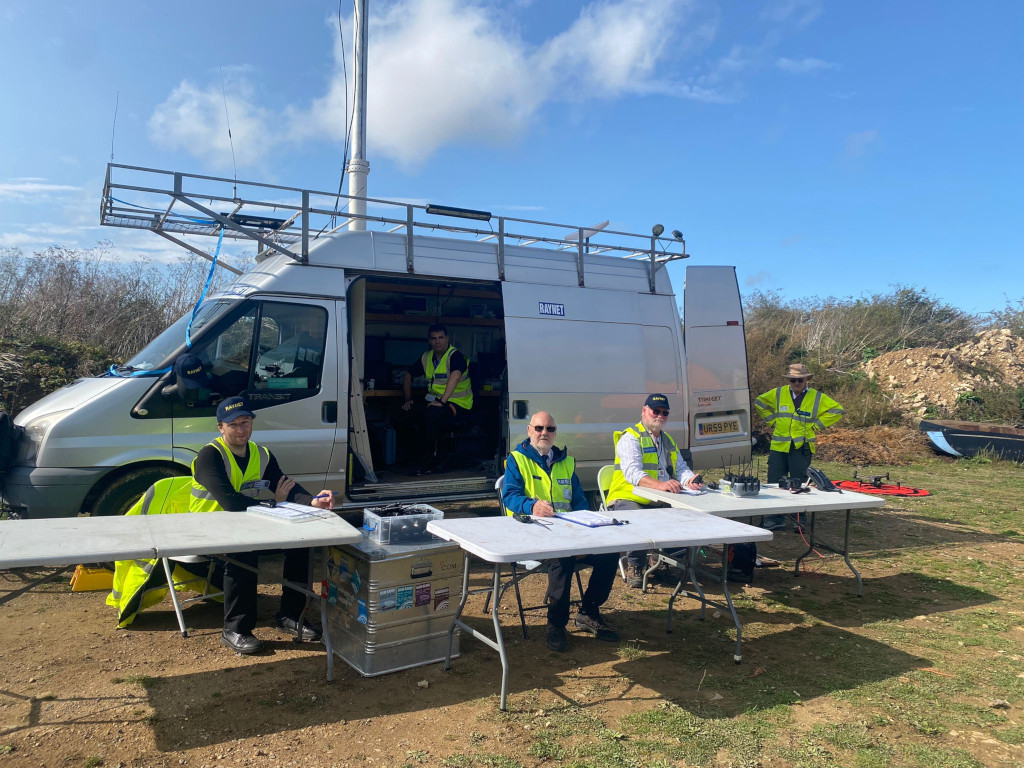
 To meet both requirements, Cambridgeshire RAYNET deployed their Incident Communications Vehicle firstly to Wansford Station and then to the Forward Control Post (FCP) near the incident site at Yarwell Junction Railway Station, supported by a number of its volunteers.
When the local communications failure was simulated, some 30 or so PMR (private mobile radio) personal radios were deployed to the emergency services personnel programmed for a number of UHF simplex radio channels that were envisaged as single-agency talk groups and a common command and control radio channel which operated via a UHF PMR repeater located in RAYNET's Incident Communications Vehicle. The radio channels used were part of a Business Radio (Suppliers Light) Licence that the Cambridgeshire Group of RAYNET held.
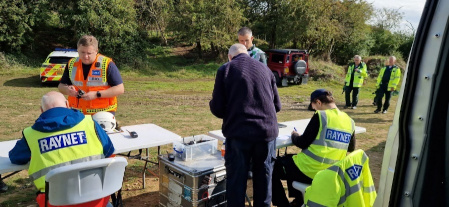
The image on the right shows the Incident Communications Vehicle and the JESIP 'huddle' discussing the deployment of the hand-held radios at the incident's Forward Command Post.
Predicted Radio Path Model
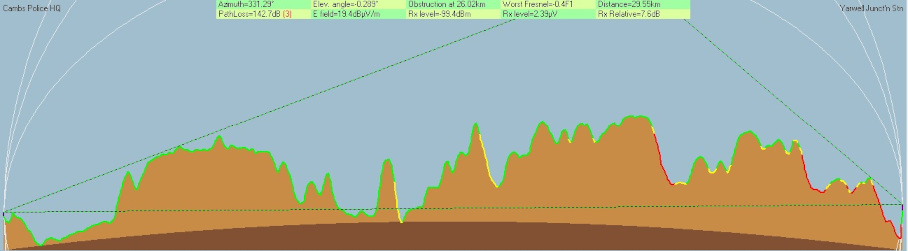 The 30km link from the incident site to TCG was obviously a key challenge due to the terrain. Computer modelling suggested that the RF path loss would be in the order of 143dB or about 2μV at the receiver for a 10 watt transmitter with 0dBd gain antennas at each end. .
The rules of the exercise did not allow us to conduct RF tests before the exercise. Remembering that this is only a computer model the Group were concerned about signal strengths on the day so chose to deploy large high-gain Yagi antennas at each end (approx 12dB gain each, for a total of 24dB (250 times in old money) ). As it turned out, this was far more than needed and signals from Yarwell were weakly audible at times using just a hand-held radio at Constabulary HQ.
With the uncertainty of achieving a reliable VHF link, the Group then planned for a primary solution with three fallback solutions according the principles of 'PACE' - Primary, Alternate, Contigency, Emergency:
- An AllStarLink voice link via a satellite broadband ground station from the Forward Control Post near incident site to a 4G router located on a vehicle mast outside the TCG at Hinchingbrooke. The internet link was coupled to simplex UHF radios on a PMR channel at each end, giving good coverage to several hand-held radios in the conference room where TCG was being held and also at the incident site.
- A fallback VHF link on amateur radio frequencies between the two sites using tall pneumatic masts at each end with high-gain Yagi antennas (9 element Yagi at Yarwell and a 13 element Yagi at Hinchingbrooke). The VHF link would provide communications through VHF/UHF cross band repeaters to UHF hand-held personal radios at both TCG and at the incident site.
- A further fallback considered was the deployment of video conferencing between RAYNET's Incident Communications Vehicle via the satellite broadband link (Starlink) and the conference room via the internet.
- A final fallback would be to use the Amateur repeater station GB3PE, located along the RF path between TCG and the Incident Site at Washingley SW of Peterborough and would provide strong RF signals to both locations.
Execution of the plan
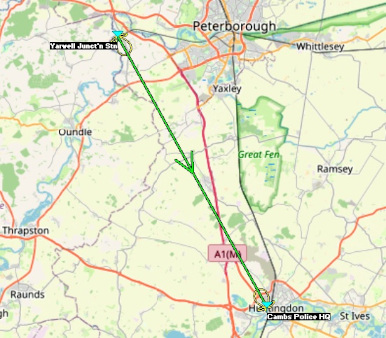 Plan 1 utilised a commercial Starlink board-band satellite service, with a ground station installed in RAYNET's Incident Communications Vehicle at the Forward control post and a 4G router located on a vehicle mounted mast close to TCG.
The RAYNET teams operating at both ends of the 30km link arrived on site and performed initial testing which looked promising. The Starlink satellite link at the incident site with the 4G router at TCG initially synchronised well and test messages were successfully passed between sites easily. However, the 4G signal started dropping out and became unreliable, so that Plan 1 was discarded. Later investigation indicated that the 4G signal appeared to drop-out when passenger trains stopped at the near-by Railway Station.
Plan 2 involved a trailer mounted portable 12 metre pump-up mast at Hinchingbrooke with a 19 element Yagi antenna oriented on the bearing of 331° with the Incident Communications Vehicle's 20 metre mast with a 9 element Yagi antenna. As the exercise developed the Incident Communications Vehicle relocated from the initial RVP at Wansford Railway Station to the Forward Control Post at the incident site near to Yarwell Junction Railway Station. When the Incident Communications Vehicle's on-board 20 metre pump-up mast and 9 element Yagi antenna were deployed strong RF signals in both directions were observed. As a result, this option was used for the exercise.
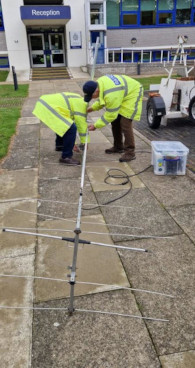 For the technically minded, the Group conducted full Electro-magnetic Force (EMF) compliance calculations to ensure safe working for those at both locations as now required by Ofcom, particularly following the deployment of high gain Yagi antennas. The Group used the
RSGB web application[3] for calculations. Although the antenna effective radiated power (ERP) levels were very high, nearing 2kW, the deployment of a high portable mast ensured more than twice the compliance distance required vis ICNIRP 2020 limits (ITU-T K.52 and PAEC-2 V1.0).
For the technically minded, the Group conducted full Electro-magnetic Force (EMF) compliance calculations to ensure safe working for those at both locations as now required by Ofcom, particularly following the deployment of high gain Yagi antennas. The Group used the
RSGB web application[3] for calculations. Although the antenna effective radiated power (ERP) levels were very high, nearing 2kW, the deployment of a high portable mast ensured more than twice the compliance distance required vis ICNIRP 2020 limits (ITU-T K.52 and PAEC-2 V1.0).
The exercise's communications were initially constrained to two Airwave talk-groups. When RAYNET deployed the multi-channel UHF single frequency hand-held personal radios, the various emergency services split into additional talk-groups, using each of the eight channels available.
Plan 3 involved the utilisation of Starlink satellite service to provide videoconferencing between the incident site and TCG where it was projected onto a large screen. Although Plan 2 fulfilled the required communications link, the functionality of Plan 3 was used to provide live video from the Incident Communications Vehicle's onboard web camera to TCG. This drew a surprised remark from a police communications officer, when the BTP Incident Commander came into view while speaking to her over the radio link. She remarked that this was a first - she'd never before been able to see the person she was talking to by radio.
As for Plan 4 - the Amateur radio repeater (GB3PE) was not deployed for live traffic, but used as an engineering talk-back channel whilst setting to work Plans 1 & 2 and maintaining the service during the exercise.
On-site Results
 As a bonus for the User Service at the Forward Control Post, RAYNET also deployed a VoIP telephone using the satellite broadband link. This caused significant comment amongst the participants as the non-police emergency services were able to telephone their own control rooms direct from the Forward Control Post, thus able to reduce the amount of traffic routed through the police operator at TCG.
Despite initial concerns about the incident site terrain - some of the operations inside the railway tunnel as well as in the deep railway cutting leading up to the tunnel portal - the radios and repeater combination worked well on the site and drew approving comments from the participants.
Overall, the exercise proved to be successful, meeting all the objectives for RAYNET and delivering not only what had been asked for but considerably exceeding expectations.
The Group wish to thank Cambridgeshire & Peterborough Local Resilience Forum for inviting RAYNET-UK to participate in Exercise White Nile.
Further photos from the Exercise Site